



Las Vegas is one of the harshest environments in the country for a car’s cooling system. When summer temperatures regularly exceed 110 degrees Fahrenheit and stop-and-go traffic on the 215 or the I-15 keeps the engine working hard with minimal airflow, every cooling system component is under constant stress. For Jaguar owners, the thermostat housing is one of the first components to show the effects of that stress — and when it fails, the consequences range from inconvenient to catastrophic depending on how quickly it’s caught. European Motor Cars on Spring Mountain Road has been diagnosing and repairing Jaguar cooling system issues for Las Vegas drivers for years. Here’s what you need to know about thermostat housing failures on Jaguar vehicles.
What the Thermostat Housing Does
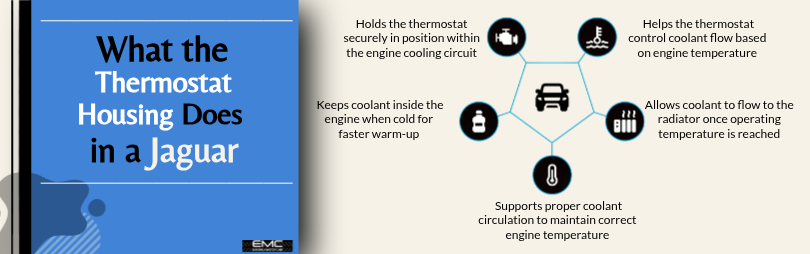
The thermostat housing is the structural assembly that holds the thermostat in position within the engine’s cooling circuit. The thermostat itself is a wax-pellet valve that stays closed when the engine is cold — keeping coolant within the engine to help it reach operating temperature faster — and opens once the engine reaches its design temperature, allowing coolant to flow through the radiator and cool down. The housing that holds all of this together is typically made of plastic or a plastic-and-metal composite on modern Jaguar engines. It includes coolant passage ports, a temperature sensor boss, and integrated sealing surfaces. On Jaguar’s supercharged V8 engines and their inline-four variants, this housing is a single integrated unit that contains both the thermostat and its seat.
How the Housing Fails on Jaguars
Jaguar thermostat housings fail in two distinct ways depending on the model and engine. The first is outright cracking of the plastic body, particularly on vehicles with higher mileage and heat exposure. Plastic that has been repeatedly heated and cooled over years loses its flexibility and becomes brittle. In Las Vegas, where ambient temperatures push engine bay temperatures higher and coolant runs hotter for longer periods, this degradation accelerates. A cracked housing leaks coolant externally, leaving visible residue around the housing, staining the engine bay, and causing gradual coolant loss that can lead to overheating if unchecked. The second failure mode is the sealing surface between the housing and the engine block or cylinder head deteriorating — the sealing gasket or O-ring fails, allowing coolant to leak at the mating surface even when the housing body itself is intact.
Warning Signs of a Failing Thermostat Housing
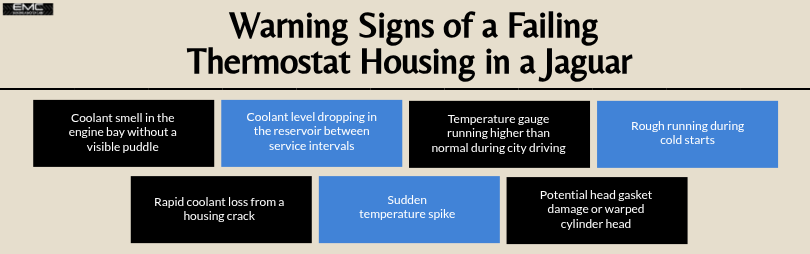
The earliest sign of thermostat housing trouble on a Jaguar is often coolant smell in the engine bay without a visible puddle — the leak is small enough that coolant evaporates before it drips. As the failure progresses, the coolant reservoir level drops between service intervals, the temperature gauge climbs higher than usual during sustained city driving, and in some cases the engine runs rough at cold start because the thermostat is no longer seating properly. In worst-case scenarios, a catastrophic housing crack results in rapid coolant loss, a sudden temperature spike, and potential head gasket damage or warped cylinder head. European Motor Cars’ technicians use pressure testing and UV dye inspection to identify cooling system leaks before they reach this stage.
Repair Options and What to Expect
Replacing a Jaguar thermostat housing typically involves draining the cooling system, removing the housing assembly along with its integrated thermostat, and installing a new unit with a fresh gasket or O-ring. On some Jaguar models the housing is accessible and the repair is relatively straightforward; on others it sits behind intake components or coolant pipes that must be moved first. European Motor Cars uses quality replacement parts that meet or exceed Jaguar’s specifications, and all coolant work is completed with a proper bleed procedure to eliminate air pockets from the system. The repair comes with a 40-month/40,000-mile warranty, so you drive away knowing the cooling system is sound.
European Motor Cars: Las Vegas’s Jaguar Cooling System Specialists
European Motor Cars at 3440 Spring Mountain Rd. in Las Vegas serves Jaguar owners throughout the Las Vegas valley including Henderson, Summerlin, Spring Valley, and beyond. Their ASE-certified technicians specialize in European vehicles and understand the specific demands that Las Vegas’s climate places on cooling systems. If your Jaguar is running warmer than usual, losing coolant, or showing any signs of cooling system trouble, call (702) 367-7140 to schedule a diagnosis before a small leak becomes a major repair.
FAQ
How do I know if my Jaguar’s thermostat housing is leaking?
Watch for a coolant smell in the engine bay, a dropping coolant reservoir level, or a temperature gauge that climbs higher than normal during city driving. A pressure test at a shop can confirm a leak even before it becomes externally visible.
Is a Jaguar thermostat housing a serious repair?
A small housing leak is a moderate repair if caught early. Left unaddressed, progressive coolant loss can cause engine overheating, which can damage the head gasket, warp the cylinder head, and turn a $400 repair into several thousand dollars of engine work.
Why do Jaguar thermostat housings fail more in hot climates?
Plastic thermostat housings degrade faster under high thermal stress. In Las Vegas’s extreme summer heat, engine bay temperatures are higher and the cooling system works harder, which accelerates the natural aging and embrittlement of plastic cooling system components.
Does European Motor Cars service all Jaguar models?
Yes. European Motor Cars works on the full Jaguar lineup including XE, XF, XJ, F-Type, E-Pace, F-Pace, and I-Pace, covering routine maintenance and complex cooling system and drivetrain repairs.